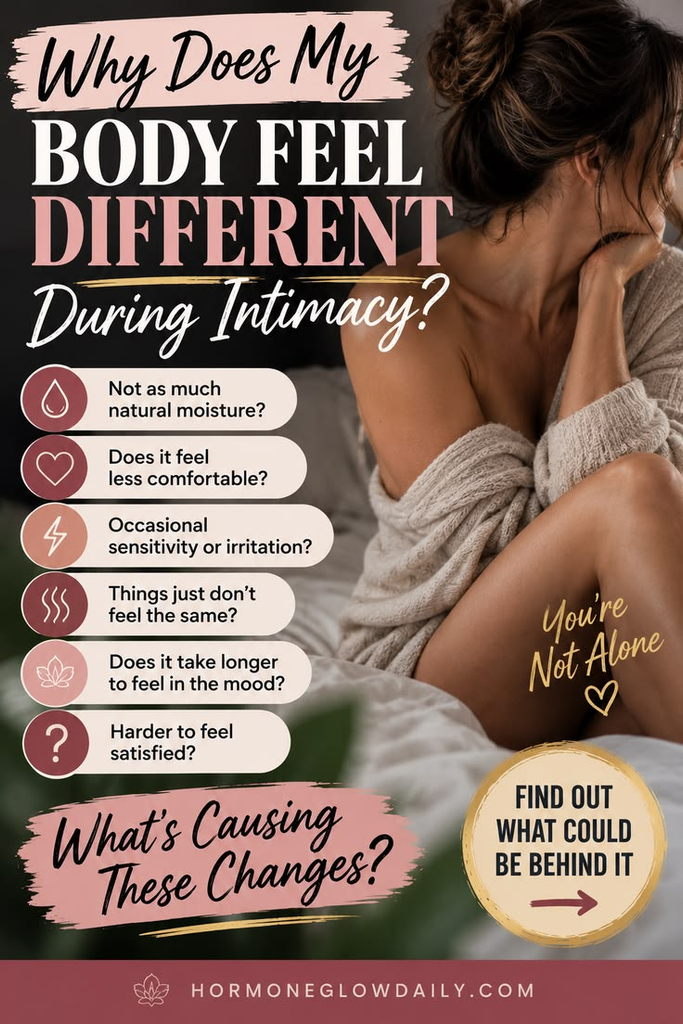
The intimate changes women often don’t talk about—but don’t have to simply accept
You may have noticed something you weren’t expecting.
Sex used to feel good.
Now it hurts.
Maybe you aren’t as interested in sex as you used to be. Maybe you find yourself avoiding intimacy because you already know what might happen. Or perhaps you still want to be close to your partner, but your body doesn’t seem to respond the way it once did.
And then comes the question many women quietly ask themselves:
“What happened to me?”
If you’re going through perimenopause or menopause, changes in your sex life can be surprisingly common. And they’re not necessarily happening because you’ve stopped loving your partner, become less feminine, or somehow “lost” your sexuality.
Changes in hormones, vaginal tissues, lubrication, sleep, stress, mood, medications, relationships, and overall health can all influence sexual function.
The important part is this:
You don’t have to assume that painful or uncomfortable sex is simply something you have to live with.
Let’s talk about what’s actually happening.
1. Why Did Sex Suddenly Start Hurting?
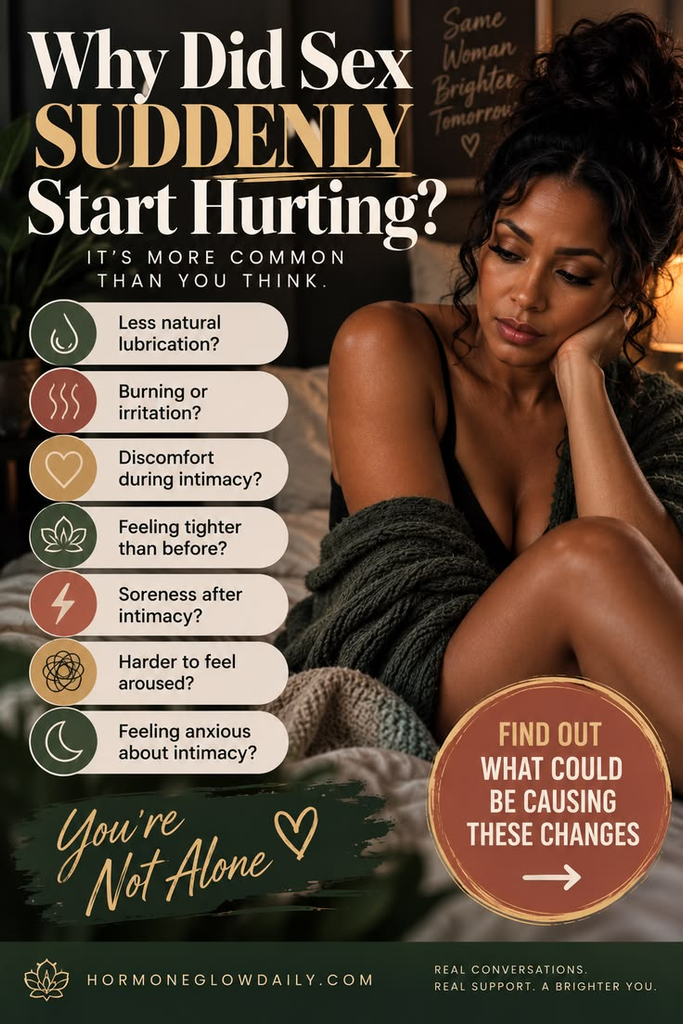
This is one of the biggest changes that can catch women completely off guard.
You may have had years of comfortable sex and suddenly notice:
- Burning
- Stinging
- Dryness
- Soreness
- Tightness
- Pain with penetration
- Pain afterward
- Feeling irritated afterward
- Light bleeding after sex
- Feeling like your body isn’t lubricating the way it used to
One important reason can be the hormonal changes surrounding menopause.
As estrogen declines, vaginal and vulvar tissues can become thinner, drier, and less elastic. Vaginal lubrication can decrease, and penetration may become uncomfortable or painful. This group of symptoms is often referred to as genitourinary syndrome of menopause (GSM).
And here’s something important:
Pain can actually change your desire for sex.
Think about it.
If your brain starts associating intimacy with:
“This is going to hurt,”
your body may naturally become less interested in repeating the experience.
That can create a frustrating cycle:
Dryness → friction → pain → anxiety about sex → less arousal → less lubrication → more discomfort.
So if you’ve been wondering why your desire has changed, pain may be part of the story.
2. Why Does My Body Feel Drier Than It Used To?
Vaginal dryness isn’t simply about whether you’re “in the mood.”
Hormonal changes can affect the vaginal tissues themselves.
Lower estrogen can contribute to reduced lubrication and less elasticity. The tissues may also become more sensitive and prone to irritation.
You might notice:
- You need much more time to become comfortable
- Your usual lubricant doesn’t seem sufficient
- Penetration feels uncomfortable
- You feel sore afterward
- Certain underwear or clothing bothers you
- You experience burning or irritation
- Sex feels more like friction than pleasure
This is why simply telling yourself to “relax” doesn’t necessarily solve the problem.
Your body may genuinely be experiencing a physical change.
3. Why Did My Desire Just Disappear?
This one can feel especially emotional.
You may think:
“I still love my partner. So why don’t I want sex?”
The answer isn’t always one thing.
The Menopause Society explains that sexual desire during midlife can be influenced by multiple factors, including hormone changes, sleep problems, medications, mood, stress, relationships, body image, and other health factors.
And there’s an important misconception to clear up:
Lower desire doesn’t automatically mean something is wrong with your relationship.
Sometimes your body and mind are simply dealing with much more than they used to.
Consider what can happen during perimenopause:
You aren’t sleeping well.
You’re exhausted.
You’re experiencing hot flashes or night sweats.
You’re stressed.
Your mood is changing.
Your body feels unfamiliar.
You’re dealing with vaginal dryness.
Sex has become uncomfortable.
You’re taking a medication that affects sexual function.
You’re worried about aging.
You’re overwhelmed with work, family, caregiving, or other responsibilities.
Put all of that together and it’s understandable that sex might move lower on your priority list.
4. Pain Can Make You Lose Interest in Sex
This connection is particularly important.
Imagine sex has become painful several times.
Eventually, you may start thinking about the pain before sex even begins.
You may avoid initiating intimacy.
You may make excuses.
You may hope your partner doesn’t ask.
You may feel guilty.
Your partner may interpret your lack of interest personally.
And suddenly, something that started as a physical problem can become an emotional and relationship problem too.
The Menopause Society notes that vaginal changes and pain can contribute to decreased sexual desire, and sexual concerns frequently overlap.
So if your desire disappeared after sex became uncomfortable, don’t automatically assume your attraction disappeared.
Your body may have learned to anticipate discomfort.
5. Why Does Sex Feel Different Now?
Sometimes the problem isn’t simply pain.
You may think:
“I don’t know how to explain it. Sex just feels… different.”
You might notice:
- Less sensation
- Less lubrication
- More sensitivity
- A feeling of tightness
- Difficulty becoming aroused
- Difficulty reaching orgasm
- Needing more stimulation
- Feeling disconnected from your body
- Less spontaneous desire
- More discomfort afterward
Sexual function isn’t just one thing.
It includes desire, arousal, orgasm, and pain, and changes in one area can affect another.
For example:
Less desire → less arousal → less lubrication → more friction → pain.
Or:
Pain → fear of pain → avoiding sex → less desire.
Or:
Poor sleep → exhaustion → less interest in intimacy.
That’s why looking at the entire picture is often more useful than searching for one “hormone imbalance.”
6. What About Orgasms?
You may also notice that your orgasms have changed.
Maybe they’re:
- Harder to reach
- Less intense
- Taking longer
- Less predictable
- Different from what you’re used to
That doesn’t mean your sexuality is gone.
Changes in hormones, vaginal tissues, arousal, medications, stress, relationship factors, and overall health can all influence sexual response.
And there’s no required “normal” amount of sex or desire that every woman is supposed to have.
Some women experience less desire during midlife.
Some experience no change.
Some actually experience more sexual interest.
The goal isn’t to force yourself back into some previous version of yourself.
The goal is to understand what your body is experiencing now.
7. What Can Actually Help?
The good news is that you have options.
And they don’t all involve hormones.
Start with lubrication
If dryness or friction is contributing to discomfort, a lubricant can reduce friction during sexual activity.
Water-based, silicone-based, and some oil-based lubricants are options, although product ingredients matter if you have sensitive skin or are prone to irritation.
If you’re using condoms, check the lubricant’s compatibility with the type of condom you’re using.
Lubricant vs. vaginal moisturizer
These aren’t exactly the same thing.
Lubricants are generally used during sexual activity to reduce friction.
Vaginal moisturizers are designed for more regular use to help maintain moisture.
The Menopause Society lists both lubricants and vaginal moisturizers among options for vaginal dryness and discomfort.
8. Don’t Ignore Vaginal Dryness or Pain
This is where I really want women to stop telling themselves:
“I guess this is just what happens when you get older.”
You don’t have to simply tolerate persistent pain.
If dryness, burning, irritation, or painful sex continues, talk with your healthcare professional.
There are medical treatments available.
Depending on your symptoms and medical history, a clinician may discuss options such as:
- Vaginal moisturizers
- Lubricants
- Low-dose vaginal estrogen
- Vaginal DHEA
- Ospemifene
- Other individualized treatments
The appropriate option depends on the underlying cause and your personal medical situation.
9. What If I Don’t Want Hormones?
It’s completely reasonable to have questions about treatment.
But it’s also important not to assume that “non-hormonal” automatically means better or safer for everyone.
There are nonprescription options for some symptoms, including lubricants and vaginal moisturizers.
Lifestyle and relationship factors can matter too.
And counseling or sex therapy can be useful when stress, anxiety, relationship difficulties, negative body image, or other emotional factors are affecting sexual function.
The right approach is the one that addresses what is actually causing your symptoms.
10. Don’t Forget Sleep
Here’s another connection that can easily get overlooked.
If you’re waking up at 2 a.m., sweating through your pajamas, struggling to fall back asleep, and dragging yourself through the next day…
you may not exactly be thinking:
“I can’t wait for sex tonight.”
Sleep disruption can affect energy, mood, stress, and sexual interest. The Menopause Society specifically notes that poor sleep associated with menopausal symptoms can reduce interest in sex.
So sometimes improving your overall well-being can be part of improving your intimate life too.
11. Talk to Your Partner Before the Problem Gets Bigger

This can be incredibly difficult.
Especially when you’re embarrassed.
You might not know how to say:
“I’m still attracted to you, but my body doesn’t feel the same.”
Or:
“Sex has started hurting and I haven’t known how to tell you.”
Or:
“I want intimacy, but I need us to slow down.”
Your partner may otherwise assume your lack of interest means:
- You’re no longer attracted to them
- You’re angry
- You don’t love them
- You’re rejecting them
When the real issue may be physical discomfort or hormonal changes.
A simple conversation can remove some of that pressure.
You don’t have to solve everything in one conversation.
Start with honesty.
12. When You Should Talk to a Doctor

Please don’t automatically assume every vaginal or sexual symptom is caused by perimenopause.
New or persistent symptoms can have other causes.
It’s particularly important to seek medical evaluation if you’re experiencing:
- Persistent vaginal burning
- Significant pain
- Bleeding after sex
- Unusual discharge
- Strong or unusual odor
- Severe itching
- Burning with urination
- Recurrent urinary symptoms
- Pelvic pain
- Symptoms that are getting worse
Some infections, skin conditions, urinary problems, medications, and other medical conditions can produce symptoms that overlap with menopause-related changes.
That’s why a proper evaluation matters.
The Most Important Thing to Remember
If sex suddenly hurts…
If your desire suddenly disappears…
If your body responds differently…
you are not necessarily “broken.”
Your sexual health is part of your overall health, and the menopause transition can affect several pieces of sexual function at once.
But you don’t have to quietly accept discomfort.
You can investigate what’s happening.
You can communicate with your partner.
You can use products that reduce friction when appropriate.
You can talk with a healthcare professional about treatment options.
And you can give yourself permission to have a different sexual experience than you did 10 or 20 years ago.
Your goal isn’t to become your younger self again.
It’s to feel comfortable, informed, connected, and confident in the body you have now.
❤️ If This Sounds Like You…
If you’re experiencing several perimenopause changes at once—sleep problems, mood changes, energy crashes, cravings, bloating, stress, or feeling unlike yourself—don’t try to change everything overnight.
Start with small, realistic steps.
Download the free 7-Day Hormone Reset Starter Guide from Hormone Glow Daily and use it as a simple starting point for supporting your overall wellness during this transition.
Medical Disclaimer
This article is for educational purposes only and is not medical advice or a substitute for professional medical care. Sexual or vaginal symptoms can have many causes, and persistent, severe, or new symptoms should be evaluated by a qualified healthcare professional.
Affiliate Disclosure: Some of the links in this article are affiliate links, which means Hormone Glow Daily may earn a small commission if you purchase through one of these links, at no additional cost to you. We only recommend products we believe may be helpful and relevant to the topic discussed. Our recommendations are not influenced by commissions, and you are never required to purchase anything.